
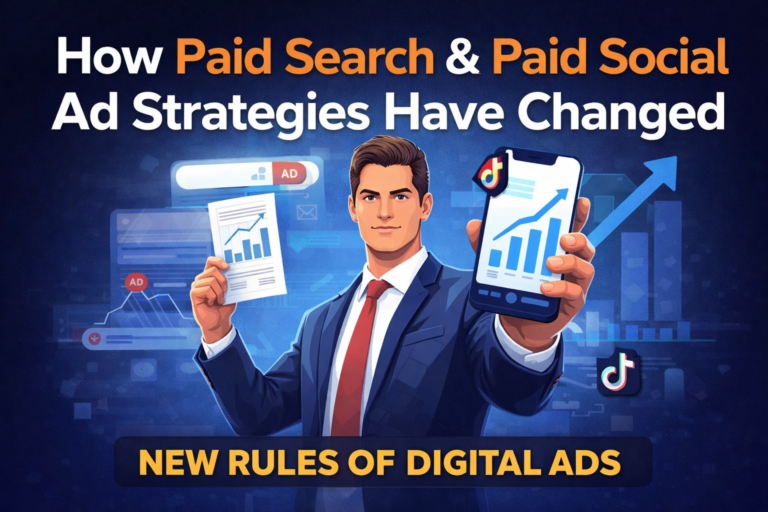
Over the last two years, digital advertising has changed in a fundamental way. Brands are no longer focused on getting as many clicks, views, or impressions as possible. Instead, they are prioritizing what truly matters: efficiency, automation, and measurable business results.
This shift reflects a more mature approach to marketing. Companies are no longer satisfied with “looking busy” online. They want advertising systems that generate consistent revenue and long-term growth.
Recent performance data from search and social platforms shows that advertisers are becoming more disciplined, more strategic, and more focused on profitability than ever before.
1. Paid Search
Paid search remains one of the most reliable channels in digital marketing. Platforms like Google continue to deliver strong results, but the way advertisers use them has evolved.
Better Results Without Higher Costs
Over recent quarters, click-through rates in paid search have increased while cost-per-click has remained relatively stable. This means advertisers are getting more engagement without paying significantly more.
This improvement is not accidental. It comes from:
-
Better keyword selection
-
More relevant ad copy
-
Smarter bidding strategies
-
Improved landing pages
Instead of simply increasing budgets, marketers are optimizing their systems.
Performance Max Is Changing Search Strategy
One of the biggest changes in paid search is the rise of automated campaign types, especially Performance Max.
These campaigns use artificial intelligence to distribute ads across multiple Google platforms automatically. While they often come with slightly higher costs per click, they offer:
-
Wider reach
-
Better data integration
-
Faster learning
-
Stronger conversion signals
For many businesses, Performance Max has become the foundation of their search strategy.
What This Means for Advertisers
Search advertising is no longer about managing hundreds of small keyword campaigns manually. It is about building strong data systems and letting algorithms work efficiently.
Advertisers who understand automation and feed it with good data are winning.
2. Paid Social
Social media advertising has gone through a major transformation.
In the past, platforms like Facebook and Instagram were mainly used for reach and branding. Today, they play a central role in driving sales.
Fewer Impressions but Better Results
Recent data shows that advertisers are often buying fewer impressions than before, while paying higher prices per thousand views.
This might seem negative, but it actually reflects a smarter strategy.
Instead of showing ads to everyone, brands are focusing on:
-
High-intent audiences
-
Purchase-ready users
-
Proven formats
-
High-performing placements
The result is better conversion quality.
The Growth of Automated Shopping Campaigns
Meta’s automated shopping formats have grown rapidly. These campaigns simplify setup and use AI to manage targeting and optimization.
Advertisers are investing more in these systems because they:
-
Reduce manual work
-
Improve learning speed
-
Scale more easily
-
Connect ads directly to sales
This reflects a broader trend: social platforms are becoming commerce engines, not just media platforms.
TikTok
TikTok continues to gain importance, especially for product discovery.
Many brands now use TikTok as the first step in the buying journey. Users discover products through creators and short videos, then convert later through retargeting and search.
This makes TikTok an important part of modern funnel strategies.
3. Commerce Media: The Fastest-Growing Segment
One of the strongest trends in digital advertising is the rise of commerce-focused platforms.
These include:
-
Retail media networks
-
Marketplace advertising
-
Programmatic commerce formats
-
Shopping-focused social campaigns
Why Commerce Media Is Growing
Commerce media offers something traditional advertising cannot: closed-loop data.
Advertisers can see:
-
Who clicked
-
Who bought
-
What they bought
-
How often they return
This level of visibility makes budget decisions easier and more confident.
Strong Performance With Stable Costs
Unlike many traditional channels, commerce platforms have managed to grow while keeping costs relatively stable.
This combination of scale and efficiency makes them extremely attractive for performance-focused brands.
As a result, many companies are shifting larger portions of their budgets into these environments.
4. The End of “More Traffic at Any Cost”
For many years, digital marketing was dominated by one idea: more traffic equals more success.
That mindset is disappearing.
Today’s leading advertisers care more about:
-
Profit per customer
-
Customer lifetime value
-
Incremental revenue
-
True return on ad spend
They are willing to accept lower traffic volumes if those visitors convert better.
This change is a sign of maturity in the industry.
5. Why Automation Is Now Mandatory
Automation is no longer optional in digital advertising.
Platforms are becoming more complex, and manual management cannot keep up with:
-
Real-time bidding
-
Cross-channel attribution
-
Audience modeling
-
Dynamic creative testing
Modern advertising success depends on working with algorithms, not against them.
However, automation only works well when it is supported by:
-
Clean tracking
-
Accurate conversion data
-
High-quality creatives
-
Strong product or service offers
Without these foundations, even the best AI systems will fail.
6. Creative Quality Is More Important Than Ever
As targeting becomes more automated, creative becomes the main differentiator.
When algorithms decide who sees ads, the message itself determines performance.
Brands that are winning today invest heavily in:
-
Clear value propositions
-
Strong visual identity
-
Authentic messaging
-
Continuous creative testing
In many cases, better creative delivers more growth than higher budgets.
7. Measurement Is Becoming More Sophisticated
Traditional last-click attribution no longer reflects reality.
Customers now interact with brands across multiple platforms before buying. They might see a TikTok video, click a Google ad, read reviews, and then convert through retargeting.
To understand this journey, advanced advertisers use:
-
Server-side tracking
-
Conversion APIs
-
Media mix modeling
-
Incrementality testing
This allows them to invest with confidence, even in complex environments.
8. What This Means for Businesses and Agencies
For business owners and agencies, these trends create both opportunities and responsibilities.
For Brands
Successful brands today:
-
Build integrated systems
-
Focus on long-term profitability
-
Invest in data infrastructure
-
Test continuously
-
Scale carefully
They treat advertising as a business asset, not an expense.
For Agencies
Modern agencies are no longer just campaign managers.
They act as:
-
System architects
-
Data consultants
-
Growth strategists
-
Creative partners
Clients expect measurable impact, not just activity.
9. The Future of Performance Marketing
Digital advertising is entering a performance-first era.
In this environment:
-
Retail media will continue to expand
-
Search will remain stable and automated
-
Social will become more commerce-driven
-
AI will manage most optimization tasks
The companies that succeed will be those that connect these channels into unified customer journeys.
Fragmented strategies will struggle.
Final Thoughts: Strategy Beats Spend
The most successful advertisers today are not those with the largest budgets.
They are the ones who learn the fastest, adapt the quickest, and build the strongest systems.
Modern performance marketing is no longer about mastering individual platforms. It is about designing intelligent, connected ecosystems that turn attention into revenue.
In this new reality, strategy is the real competitive advantage.
Book a Free Ad Account Audit